The Fireplace Wall Stack, From Floor to TV
Above a fireplace, every height depends on the one below it: the opening, the clearance to the mantel, the mantel's thickness, a gap, and then the TV.
That is why there is no single right mantel height. Instead, you build the wall from the bottom up. Get the stack right and the mantel is safe, the TV is as low as it can be, and the wall looks planned.
| Layer | What sets it | Typical range |
|---|---|---|
| Top of the fireplace opening | Your fireplace | Varies by fireplace; measure yours |
| Clearance to the mantel | Code or manufacturer instructions | 12 inches or more for a projecting mantel on a masonry fireplace |
| Mantel thickness | Style and proportion | Thin floating shelf to a thick beam mantel |
| Gap above the mantel | Heat, TV mount and looks | Enough for the mount and to let the mantel breathe |
| TV | Screen size | Grows taller with every size step |
Start With the Clearance, Not the TV
The lowest your mantel can go is set by fire safety: for a masonry fireplace, a projecting mantel needs 12 inches above the opening.
That rule comes from the International Residential Code (IRC). Inside 12 inches, wood may project only 1/8 inch per inch of distance, which is trim, not a shelf (Fine Homebuilding). Gas inserts, electric units and factory-built fireplaces follow their manufacturer's instructions, which often add rules for TVs and mantels above them. Our guide explains how far a mantel sits from the fire in detail.
Heat Above the Mantel
A mantel also deflects some heat away from the wall above it, which helps protect a TV. Check your TV maker's temperature limits and your fireplace manual before mounting a screen over a fireplace that is used often.
How High Is Too High for the TV?
Home theater guides commonly suggest keeping the center of the screen within about 15 degrees above eye level; above a fireplace, most setups land at or beyond that limit.
We ran the numbers for a common setup: a fireplace opening whose top is 36 inches above the floor, a mantel 12 inches above it and 3 inches thick, a 4-inch gap, a seated viewing height (eye height) of 40 inches, and a sofa 10 or 12 feet away.
| TV size | Screen height | Center height from floor | Angle at 10 ft | Angle at 12 ft |
|---|---|---|---|---|
| 55-inch | 27 in | 68 in | 13° | 11° |
| 65-inch | 32 in | 71 in | 14° | 12° |
| 75-inch | 37 in | 73 in | 16° | 13° |
| 85-inch | 42 in | 76 in | 17° | 14° |
Estimates from simple geometry with the assumptions above. Your opening height, mantel and seating change the result; we measure your actual wall.
Two things stand out. First, every TV size lands near or above 15 degrees from 10 feet, so sitting farther back helps more than a smaller screen. Second, a tilting or pull-down mount brings the screen angle back toward your eyes when the TV has to sit high.
How Deep Should the Mantel Be With a TV Above?
With a TV above, a mantel should be deep enough to look substantial and protect the wall, but not so deep that it blocks the bottom of the screen from your seat.
| Mantel depth | Effect | Best for |
|---|---|---|
| Shallow (slim shelf) | Barely interrupts the view of the screen | Low TV positions and modern walls |
| Medium | Balances the TV visually and holds decor | Most living rooms |
| Deep (beam mantel) | Strong presence; can hide the bottom of a low TV from a low seat | Tall walls with the TV set higher or no TV |
If you want the substance of a deep beam mantel, look at floating mantel shelves built as box beams: they look solid without being heavy.
What Fits by Ceiling Height
Ceiling height decides how much wall you have above the mantel, and therefore whether a TV, a mantel or both fit comfortably.
| Ceiling height | What usually fits | Watch for |
|---|---|---|
| 8 feet | A slim mantel, or a TV on another wall | Little space between mantel and ceiling once a TV is added |
| 9 to 10 feet | A medium mantel with a mid-size TV | Keep the gap above the mantel small to lower the TV |
| 12 feet and up | A substantial mantel and a larger TV | The TV sits high; plan seating distance and a tilting mount |
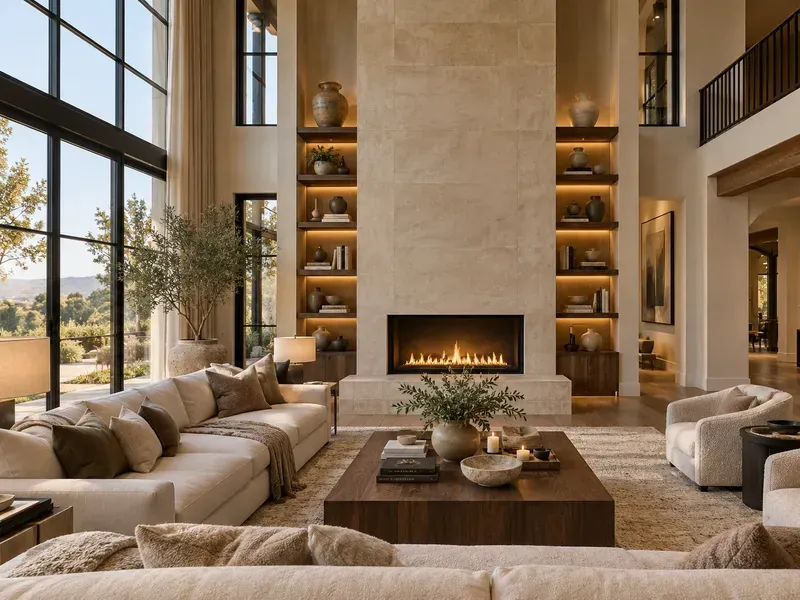
| Two-story walls | A strong mantel as the focal point | A TV here ends up very high; consider shelves or another wall |
Options When the TV Ends Up Too High
If the math puts the TV too high, you can lower the mantel's role, move the seating, tilt the screen, or move the TV.
- 1
Use a tilting or pull-down mount.
The simplest fix: the screen angles toward the sofa, and some mounts lower it when you watch.
- 2
Choose a slimmer mantel.
A thinner mantel lowers the TV by a couple of inches while keeping the shelf.
- 3
Move the seating back.
Each extra foot of distance lowers the viewing angle.
- 4
Go without a TV over the fireplace.
Shelves beside the fireplace or another wall can hold the TV, leaving the mantel as the focal point.
- 5
Skip the mantel shelf.
On some gas or electric units, flat trim and a lower TV may work better than a projecting shelf.
Weighing the investment for the whole wall? See what a custom mantel costs and which factors move the price.
Frequently Asked Questions
Short, direct answers to the questions homeowners ask most about mantel height with a TV above.
How high should a mantel be with a TV above it?
As low as the clearance rules allow: for a masonry fireplace, a projecting mantel at least 12 inches above the opening. The TV then goes above the mantel with a small gap.
How much space should be between the mantel and the TV?
Enough for the TV mount and a visual break, usually a few inches. Check your TV and fireplace instructions for heat clearances.
Is it bad to mount a TV above a fireplace?
It often puts the screen above a comfortable viewing angle. A tilting mount, more seating distance or a lower mantel position can help.
Can heat from the fireplace damage the TV?
It can. A mantel helps deflect heat, but check your TV maker's temperature limits and your fireplace manual before mounting.
What size TV fits above a mantel?
It depends on the wall height and viewing distance. Larger screens sit higher, so measure the stack from the opening up before buying.