What Is the Difference Between Real Wood and Faux Beams?
Real wood beams are made of actual lumber, while faux beams are usually molded polyurethane foam shaped and colored to look like wood. A third option, solid timber, is a single heavy piece of wood.
All three can make a plain ceiling look finished. The difference shows up in how they look at close range, how they age, how they install and whether you can ever refinish them. Before comparing, it helps to know exactly what each one is.
Real Wood Box Beams
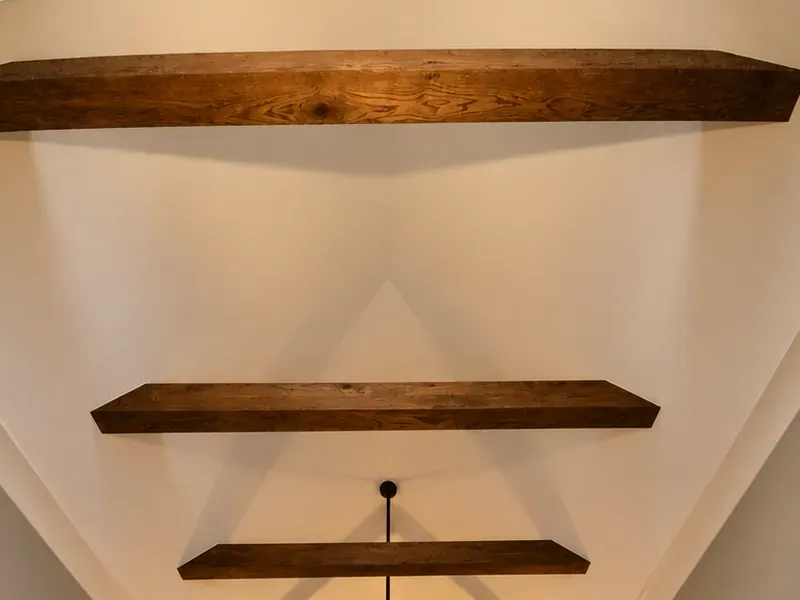
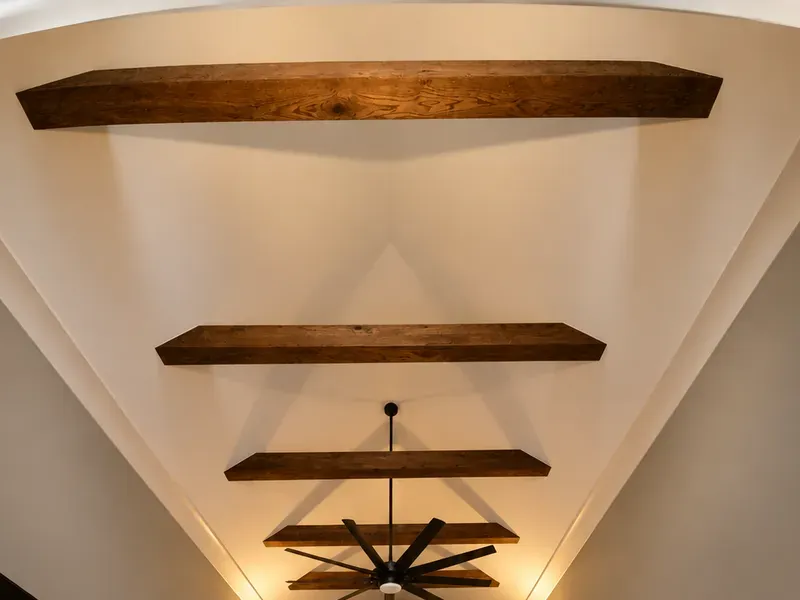
A real wood box beam is built from three boards joined into a U shape, so it reads as a solid timber from the floor. The hollow core keeps it light enough to fasten to the ceiling framing without structural changes. This is what we build in our Indian Trail shop: real lumber on every visible side, sized to your room.
Faux (Foam) Beams
Faux beams are typically made of high-density polyurethane, cast in molds that copy the texture of wood. Manufacturers describe them as decorative pieces that are not designed to carry structural loads (Barron Designs). They are very light and simple to put up, which is why they are popular for quick projects.
Solid Timber Beams
A solid timber is one piece of wood, often large and heavy. It brings authentic mass, but its weight can call for structural support, and big timbers tend to show cracks along the grain as they dry. Solid timber is common in timber-frame and structural designs.
Real Wood vs Faux Beams: Side-by-Side Comparison
For most homes, real wood box beams give the look of solid timber without the weight, and the authenticity foam can't match. The table below shows where each option wins.
| What matters | Real wood box beams What we build | Faux (foam) beams | Solid timber |
|---|---|---|---|
| Material | Real lumber on three visible sides | Molded polyurethane | One solid piece of wood |
| Look at 8 to 10 feet | Real grain, knots and texture | Can look molded or repeated | Real grain and mass |
| Weight | Light, hollow core | Very light | Heavy |
| Humidity movement | Small; boards prepared and sealed in our shop | Minimal, but it isn't wood | Most prone to cracks as it dries |
| Refinish later | Sand and restain | Paint only | Sand and restain |
| Installation | Fastened to ceiling framing | Simple, decorative only | May need structural support |
| Match to floors and cabinets | Stain chosen on the same species in your light | Factory colors | Limited by the timber you find |
| Best for | A custom look in most rooms | Lowest upfront cost and quick DIY | Structural or timber-frame designs |
The pattern is clear: foam wins on price and ease, solid timber wins on mass, and real wood box beams win on the balance most homeowners want, a believable, refinishable wood ceiling that doesn't need structural work.
How Each Beam Handles North Carolina Humidity
Real wood gains and loses a little moisture with the seasons, and foam does not. What keeps a real wood beam stable is how the boards are prepared and sealed before they reach your ceiling.
Wood naturally exchanges moisture with the air until it reaches balance with the humidity around it, so correct drying, handling and storage keep later movement small (USDA Forest Products Laboratory). In the Charlotte area, humid summers and dry, heated winters make that preparation matter.
Why Solid Timbers Crack More
A large timber dries from the outside in, so its surface shrinks before its core. That uneven wood drying is what opens the long cracks, called checks, along the grain. Many people like the character; others see it as a defect.
How Box Beams Stay Stable
Box beams are built from boards, which reach a steady moisture level more evenly than a thick timber. We choose and prepare every board in our shop and seal each finished beam, and our work carries a 5-year warranty on materials and labor.
Where Foam Has the Edge
Because foam isn't wood, it doesn't swell or shrink with humidity. That makes it practical for damp spaces where you only need the look of a beam and no one will see it up close.
Which Looks Better Up Close?
The closer a beam is to your eye, the more real wood matters. On low ceilings, lofts and stair landings, molded texture is easy to spot; on very tall ceilings, the difference shrinks.
Standard and Low Ceilings
In a room with a typical ceiling height, guests see the beams from a few feet away. Real wood grain, natural color variation and crisp mitered edges read as craftsmanship. A repeated mold pattern reads as a product.
Tall and Vaulted Ceilings
On a two-story great room, distance softens detail. Even here, real wood holds up better in daylight and under lighting aimed at the ceiling, and it ties in with real wood floors and cabinets below. Our guide to ceiling beam spacing covers how size and layout change on tall ceilings.
Next to Other Real Wood
The hardest test for a faux beam is a room full of real wood. When beams sit near hardwood floors, a wood mantel or floating shelves, mismatched tones and textures stand out. With real wood, we can build the beams in the same species and stain as the rest of the room.
Cost and Long-Term Value
Foam usually costs the least up front, real wood box beams cost more, and solid timber costs the most. Over time, real wood's value comes from being refinishable and from matching the rest of a well-built home.
The price of any beam project depends on the wood species, beam size, the number and length of beams, the ceiling height and shape, and the finish. We don't publish a single price, because every ceiling is different. Our guide on what changes the cost of ceiling beams walks through each factor.
Long-term value is less about the first invoice and more about the next ten years. A real wood beam can be sanded and restained if you change your floors or style; a foam beam can only be painted. In a home where buyers notice materials, real wood tends to read as part of the house rather than an add-on.
How to Decide: A 5-Question Checklist
Answer these five questions honestly and the right beam usually becomes obvious. If you answer "yes" to three or more, real wood box beams are the better fit.
- 1
Will people see the beams from less than 10 feet away?
Low ceilings, lofts and stair landings put beams close to the eye, where real grain matters most.
- 2
Is the room full of real wood already?
Hardwood floors, wood cabinets or a mantel make foam easier to spot and real wood easier to match.
- 3
Might you change the stain or style later?
Real wood can be sanded and restained; foam can only be painted.
- 4
Do you want the beams to look built for the house?
Custom lengths and a stain chosen in your own light make beams look original to the home.
- 5
Is this a long-term home or a high-end listing?
Materials matter more the longer you stay and the more buyers look closely.
If most of your answers are "no", the beams sit far from view, and price is the deciding factor, foam can be a reasonable choice. If you want the material itself to be the point, choose real wood. For species, see the best wood for ceiling beams.
Frequently Asked Questions
Short, direct answers to the questions homeowners ask most about real wood and faux beams.
Quick answers to what homeowners ask most when comparing real wood and faux beams.
Are faux beams the same as box beams?
Not always. "Box beam" describes the hollow, three-sided shape. Our box beams are made of real wood boards, while most faux beams are box-shaped pieces of molded polyurethane foam.
Do faux beams look real up close?
From across a room, a good faux beam can pass. Up close, the repeated texture of a mold and the lack of real grain are easier to spot, especially on lower ceilings and in rooms with real wood floors nearby.
Can real wood beams be installed on a vaulted ceiling?
Yes. We measure the slope on site and cut each beam to the angle of the ceiling. See our vaulted ceiling beams for details.
Will real wood beams crack in a humid climate?
Wood moves slightly as humidity changes, and large solid timbers are the most likely to show surface checks. We prepare and seal every board in our shop, and our work carries a 5-year warranty on materials and labor.
Which costs more, real wood or faux beams?
Faux foam beams usually cost the least, real wood box beams sit in the middle, and solid timber costs the most. The final price depends on wood species, size, number of beams and your ceiling. See what changes the cost of ceiling beams.